Preview
Review the resource before downloading
Overview
What this template helps you solve
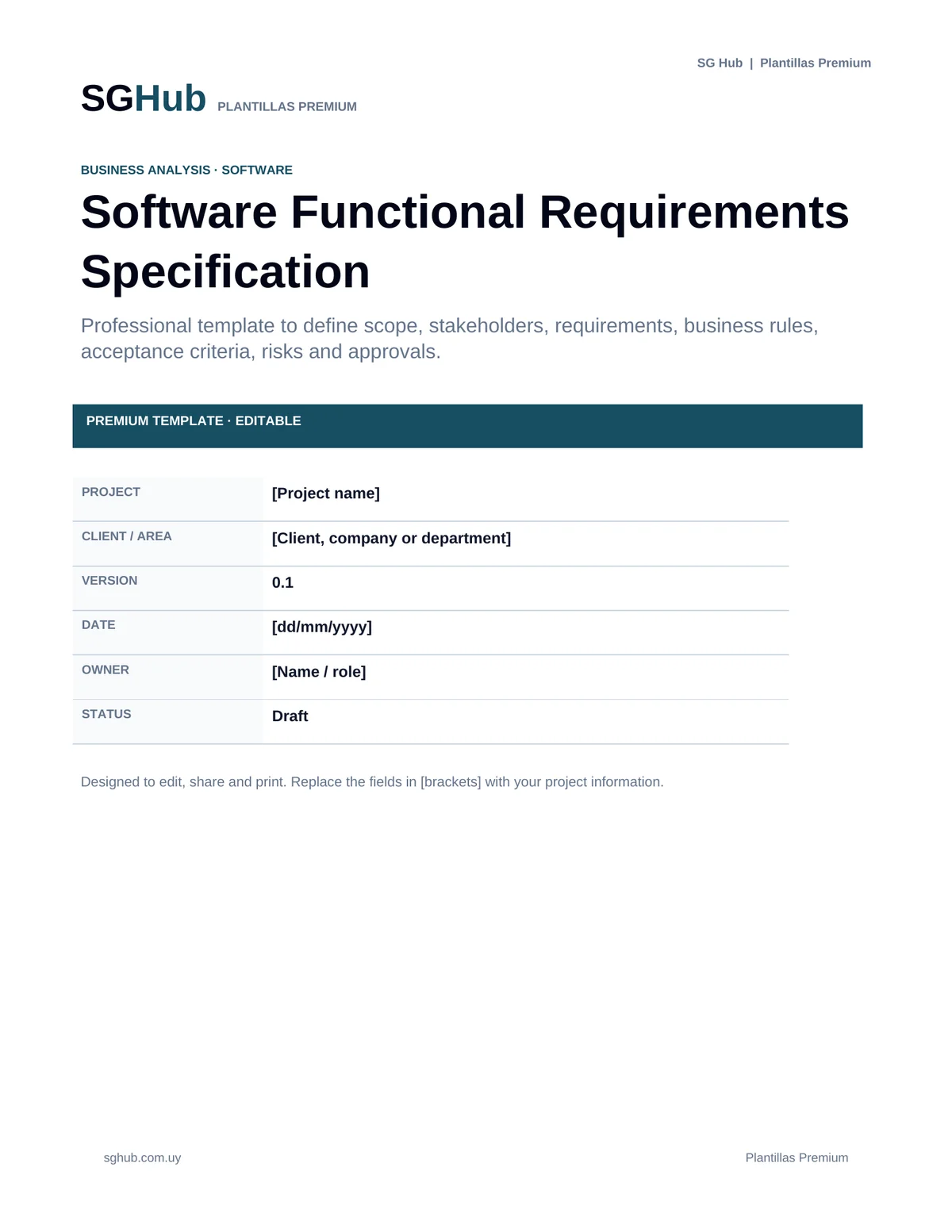
This document provides a structured foundation for turning business needs into concrete functional requirements that can be understood by analysts, developers, QA teams, product owners and key users. Its structure helps reduce ambiguity, improve reviews and document what the system must do, under which conditions and how each expected behavior will be validated.
Audience
Who is it for?
- ✓Functional Analysts and Business Analysts.
- ✓Product Owners and product managers.
- ✓Frontend, backend and full-stack developers.
- ✓QA and testing teams.
- ✓Key users and business stakeholders.
- ✓Software and ERP implementation consultants.
Contents
What is included
- ✓Project identification, version, date and owners.
- ✓Requirement objective and context.
- ✓Functional scope and exclusions.
- ✓Actors and user roles involved.
- ✓Detailed expected system behavior.
- ✓Preconditions and postconditions.
- ✓Inputs, outputs and related data.
- ✓Business rules and validations.
- ✓Main flow and alternative scenarios.
- ✓Error and exception handling.
- ✓Dependencies and integrations.
- ✓Verifiable acceptance criteria.
- ✓Priority, status and traceability.
Application
When to use this template
Document new features before development starts.
Formalize change requests for existing systems.
Prepare specifications for vendors or external teams.
Align business, development and QA around the same scope.
Create a foundation for test cases and UAT.
Document requirements for ERP, CRM or internal application implementations.
Step by step
How to use it
Step 1
Complete the project details, version and requirement owner.
Step 2
Describe the business objective and the problem the feature must solve.
Step 3
Clearly define what is inside and outside the scope.
Step 4
Identify the actors, roles and permissions involved.
Step 5
Document the main flow step by step and add alternative scenarios.
Step 6
Record business rules, validations, input data and expected results.
Step 7
Turn each important behavior into measurable acceptance criteria.
Step 8
Review the document with business, development and QA before approval.
Step 9
Update the version, status and notes whenever the scope changes.
Customization
How to adapt it to your situation
- ✓Remove sections that do not apply to your project to keep the document simple.
- ✓Add identifiers such as FR-001, FR-002 and FR-003 to improve traceability with stories, tasks and tests.
- ✓Adapt status and priority values to your team's methodology.
- ✓Include links to designs, tickets, APIs or technical documentation when they clarify the requirement.
- ✓Use functional language and avoid prescribing technical implementation unless it is a real constraint.
Important
What to review before using it
- ✓A functional requirement should describe what the system must do and how it will be verified, avoiding ambiguous terms such as fast, intuitive or appropriate without measurable conditions.
- ✓Changes approved after development starts should be recorded through a new version or change history.
- ✓This template is a general guide and should be adapted to each organization's process, regulations and required level of formality.
Avoid these
Common mistakes
- ✓Combining several independent requirements into one definition.
- ✓Describing the technical solution instead of the functional need.
- ✓Omitting exceptions, error messages or alternative scenarios.
- ✓Using subjective or untestable acceptance criteria.
- ✓Failing to identify dependencies on other modules, services or systems.
- ✓Changing scope without updating version, owners or approval.
Final review
Checklist before finishing
- ✓The requirement objective is clearly explained.
- ✓Scope and exclusions are defined.
- ✓Actors and permissions are identified.
- ✓The main flow can be followed step by step.
- ✓Relevant alternative scenarios and errors are covered.
- ✓Business rules and validations are documented.
- ✓Input and output data are identified.
- ✓Dependencies and integrations are recorded.
- ✓Acceptance criteria are specific and verifiable.
- ✓The requirement has a priority, status, owner and version.
- ✓Business, development and QA can understand the document without relying on additional explanations.
Format
File details
Includes an editable DOCX version for completing and adapting to the project, a PDF reference version and a WEBP preview to show the document before download. The structure is designed for functional software documentation and can be customized to match the team's methodology.
Frequently asked questions
Before downloading
What is the difference between a functional and a technical requirement?
A functional requirement describes what the system must do from a business or user perspective. A technical requirement defines constraints, architecture, technologies, performance, security or other implementation aspects.
How much detail should each requirement contain?
It should contain enough detail for development and QA to understand and verify the expected behavior without relying on assumptions. The exact level depends on the feature's complexity and risk.
Can I use this template with agile methodologies?
Yes. It can complement user stories, epics or tickets when a feature requires additional context, business rules or traceability.
Are acceptance criteria required?
They are strongly recommended because they turn the requirement into verifiable conditions and make development, testing, UAT and approval easier.
Should I create one document for each requirement?
Not necessarily. Related requirements can be grouped in one document as long as each one has a clear identifier and can be traced independently.
Can this template be used for ERP or CRM systems?
Yes. It can be adapted to ERP modules, CRM systems, banking applications, internal tools, web portals, APIs and other systems where functional behavior must be documented.
What should I do when the scope changes?
Record the change, update the document version, identify the modified requirements and repeat the review with the relevant stakeholders.
Can I use it as a basis for test cases?
Yes. Documented flows, rules and acceptance criteria can be converted directly into functional testing, UAT and regression scenarios.
Editorial transparency
Resource prepared and reviewed by SG Hub
This page is designed to explain not only what you can download, but also when to use the resource and what to review before applying it in a real situation.