Preview
Review the resource before downloading
Overview
What this template helps you solve
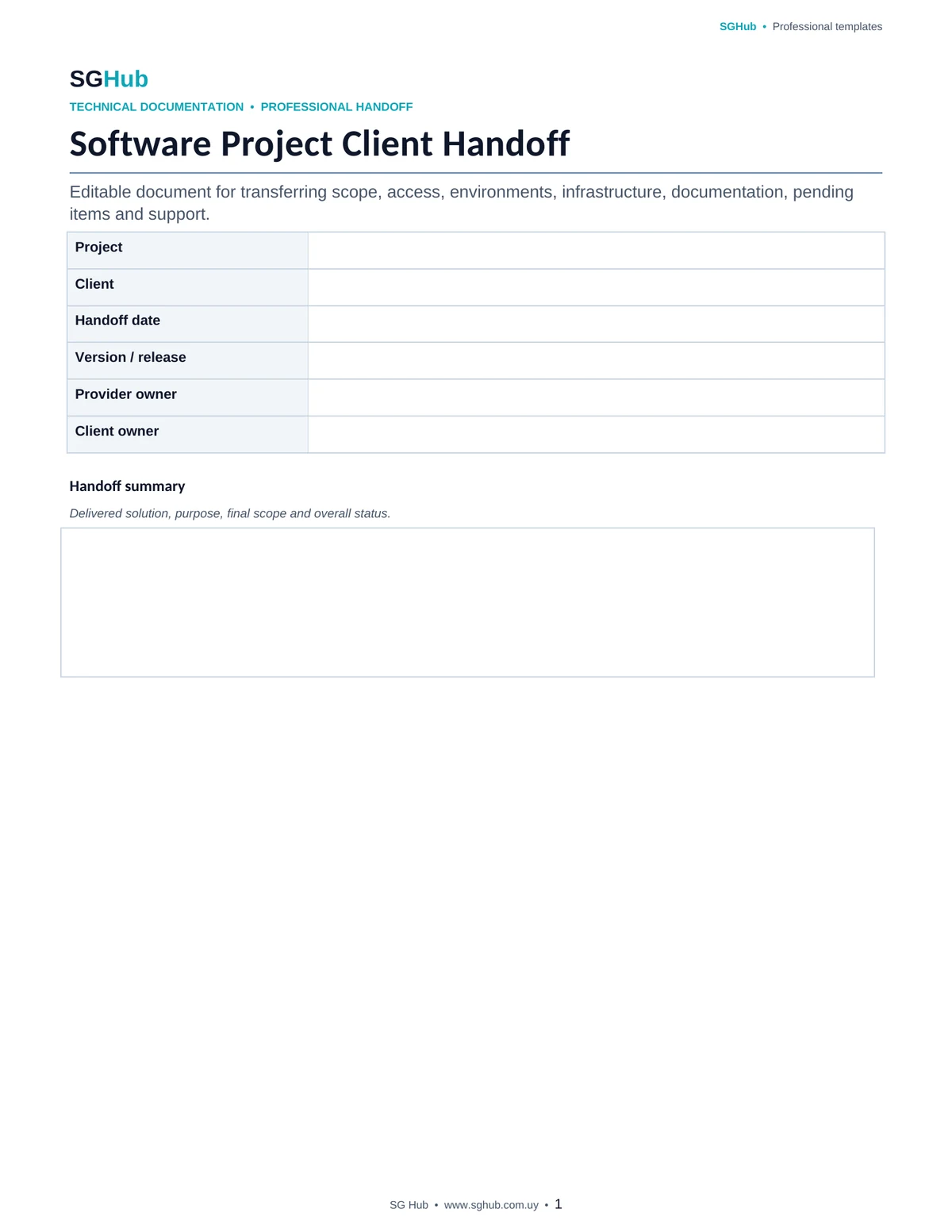
This template is designed to close the implementation stage and transfer a software project in an organized way to the client, internal team or operational owner. It centralizes information that is often scattered at the end of development: URLs, environments, accounts, owners, repositories, external services, documentation, deployment procedures, support, pending items and important decisions. Its goal is to prevent future operations from depending exclusively on the people who built the solution and to give both parties a clear reference for what is delivered, what remains pending and how to continue.
Audience
Who is it for?
- ✓Developers and agencies delivering websites, applications or platforms to clients.
- ✓Project Managers responsible for software project closure and transition.
- ✓Internal teams transferring a solution from development to operations or support.
- ✓Consultants and freelancers who need to formalize project deliverables.
- ✓Clients receiving a solution and needing access, ownership and documentation details.
- ✓SaaS teams handing off components, services or implementations between departments.
Contents
What is included
- ✓Project summary and delivered scope.
- ✓Client details and owners from both parties.
- ✓Production, staging and other environment URLs.
- ✓Code repositories and relevant branches.
- ✓Domains, DNS and associated providers.
- ✓Hosting, infrastructure and cloud services used.
- ✓Database, storage and external services.
- ✓Integrations, APIs and third-party dependencies.
- ✓Access and account ownership inventory.
- ✓Environment variable and secret references without exposing real credentials.
- ✓Deployment and update procedure.
- ✓Delivered functional and technical documentation.
- ✓Backups, monitoring and recovery information.
- ✓Known pending items, limitations and technical debt.
- ✓Post-handoff support, warranties and contacts.
Application
When to use this template
Deliver a completed website or application to a client.
Close a freelance development project with formal documentation.
Transfer a platform from an external vendor to an internal team.
Perform a handoff from development to operations or support.
Document a SaaS implementation completed for a client.
Transfer ownership of domains, hosting or external services.
Prepare the closure of a development or maintenance contract.
Reduce dependency on a single technical person after project completion.
Step by step
How to use it
Step 1
Complete the project summary describing the delivered solution, its purpose and the final approved scope.
Step 2
Identify client and provider-side owners for each relevant area.
Step 3
Record URLs, environments, domains, repositories, cloud services and integrations in use.
Step 4
Document who owns each account and how access should be managed without copying passwords into the file.
Step 5
Add references to technical documentation, functional documentation, manuals, designs and relevant procedures.
Step 6
Explain how to perform deployment, updates, backups or recovery when these tasks are part of future operations.
Step 7
Record pending items, limitations, technical debt and decisions the client should know about.
Step 8
Define what support continues after handoff, for how long and through which channel.
Step 9
Review the document with the client or receiving team and clarify any ambiguous information.
Step 10
Close the handoff with confirmation of receipt, acceptance and follow-up ownership.
Customization
How to adapt it to your situation
- ✓Remove sections that do not apply and add blocks specific to mobile, e-commerce, SaaS, APIs or infrastructure depending on the project.
- ✓Clearly separate account ownership, administrator user and operational owner to avoid future confusion.
- ✓Use links to a password manager or secure access procedure instead of including real credentials.
- ✓Add a RACI or ownership matrix when multiple companies or teams participate.
- ✓For projects with ongoing maintenance, include SLA, support hours, channels and included or excluded tasks.
Important
What to review before using it
- ✓Do not include passwords, tokens, private keys, recovery codes or real secrets in the handoff document.
- ✓The technical handoff should distinguish between access transferred to the client and accounts that remain owned by the provider.
- ✓Known pending items and limitations should be written down before acceptance to avoid different expectations between the parties.
- ✓Documentation handoff does not replace contractual, legal, intellectual property or data protection agreements when those are required.
Avoid these
Common mistakes
- ✓Delivering only the source code without explaining how to operate or deploy the solution.
- ✓Keeping domains, hosting or critical services in personal accounts without documenting ownership.
- ✓Copying passwords and secrets directly into the document.
- ✓Failing to record which environments exist and which one is production.
- ✓Leaving out third-party dependencies that generate costs or require renewal.
- ✓Failing to explain backups, deployment or recovery procedures.
- ✓Hiding known pending items, limitations or technical debt.
- ✓Closing the project without defining who will handle future incidents.
- ✓Failing to provide references to existing functional or technical documentation.
- ✓Considering the handoff complete without confirmation from the client or receiving team.
Final review
Checklist before finishing
- ✓The final delivered scope is documented.
- ✓Client and provider owners are identified.
- ✓URLs and environments are recorded.
- ✓Repositories and relevant branches are documented.
- ✓Domain and DNS ownership is clear.
- ✓Hosting and infrastructure are identified.
- ✓Databases and storage are documented.
- ✓Integrations and external services are recorded.
- ✓Ownership of each account is identified.
- ✓No passwords or real secrets were included.
- ✓The deployment procedure is documented.
- ✓Backups and recovery are explained when relevant.
- ✓Technical and functional documentation is linked.
- ✓Pending items and limitations are recorded.
- ✓Post-handoff support is defined.
- ✓The client or receiving team confirmed receipt.
Format
File details
Editable document designed as a technical and operational handoff record for software projects. It organizes scope, owners, environments, repositories, infrastructure, domains, services, integrations, access, deployments, backups, documentation, pending items and support. It can be adapted to websites, mobile applications, SaaS products, APIs, internal systems or projects involving multiple vendors.
Frequently asked questions
Before downloading
What is a software project handoff?
It is the organized transfer of knowledge, access, documentation and responsibility from the team that built or managed a solution to the client or team that will continue operating it.
Should passwords be included in the document?
No. Use a password manager, secure credential transfer or a separate procedure. The document can identify who owns the access and where it is managed without exposing the secret.
Which access should be reviewed before handoff?
Domains, DNS, hosting, cloud, repositories, databases, storage, transactional email, analytics, monitoring, payment providers, external APIs and any service required to operate the solution.
What if there are still pending tasks?
They should be clearly documented with status, owner and agreement on whether they belong to the original scope, post-project maintenance or a new phase. This helps prevent mismatched expectations.
Should the handoff include a deployment procedure?
Yes, when the client or receiving team will be responsible for future updates. The procedure should explain requirements, main steps, validation and recovery in case of failure.
Which technical documentation should be delivered?
It depends on the project, but it may include architecture, configuration, APIs, data model, deployment, integrations, monitoring, backups, troubleshooting and relevant technical decisions.
How should services that remain owned by the provider be documented?
Clearly identify the service, account owner, operational owner, usage conditions and what would happen if the relationship with the provider changes or ends.
When is the handoff considered complete?
When the delivered scope is identified, required access and documentation have been transferred, pending items are agreed upon and the client or receiving team confirms it has the information needed to continue.
Editorial transparency
Resource prepared and reviewed by SG Hub
This page is designed to explain not only what you can download, but also when to use the resource and what to review before applying it in a real situation.